

Maritime Simulators Market In 2029

Maritime Simulators Global Market Report 2026
Maritime Simulators Global Market Report 2026
Maritime Simulators Global Market Report 2026
The Business Research Company's Maritime Simulators Global Market Report 2026 – Market Size, Trends, And Global Forecast 2026-2035
LONDON, GREATER LONDON, UNITED KINGDOM, January 6, 2026 /EINPresswire.com/ -- "Maritime Simulators Market to Surpass $2 billion in 2029. Within the broader Aerospace & Defense industry, which is expected to be $1,102 billion by 2029, the Maritime Simulators market is estimated to account for nearly 0.2% of the total market value.
Which Will Be the Biggest Region in the Maritime Simulators Market in 2029
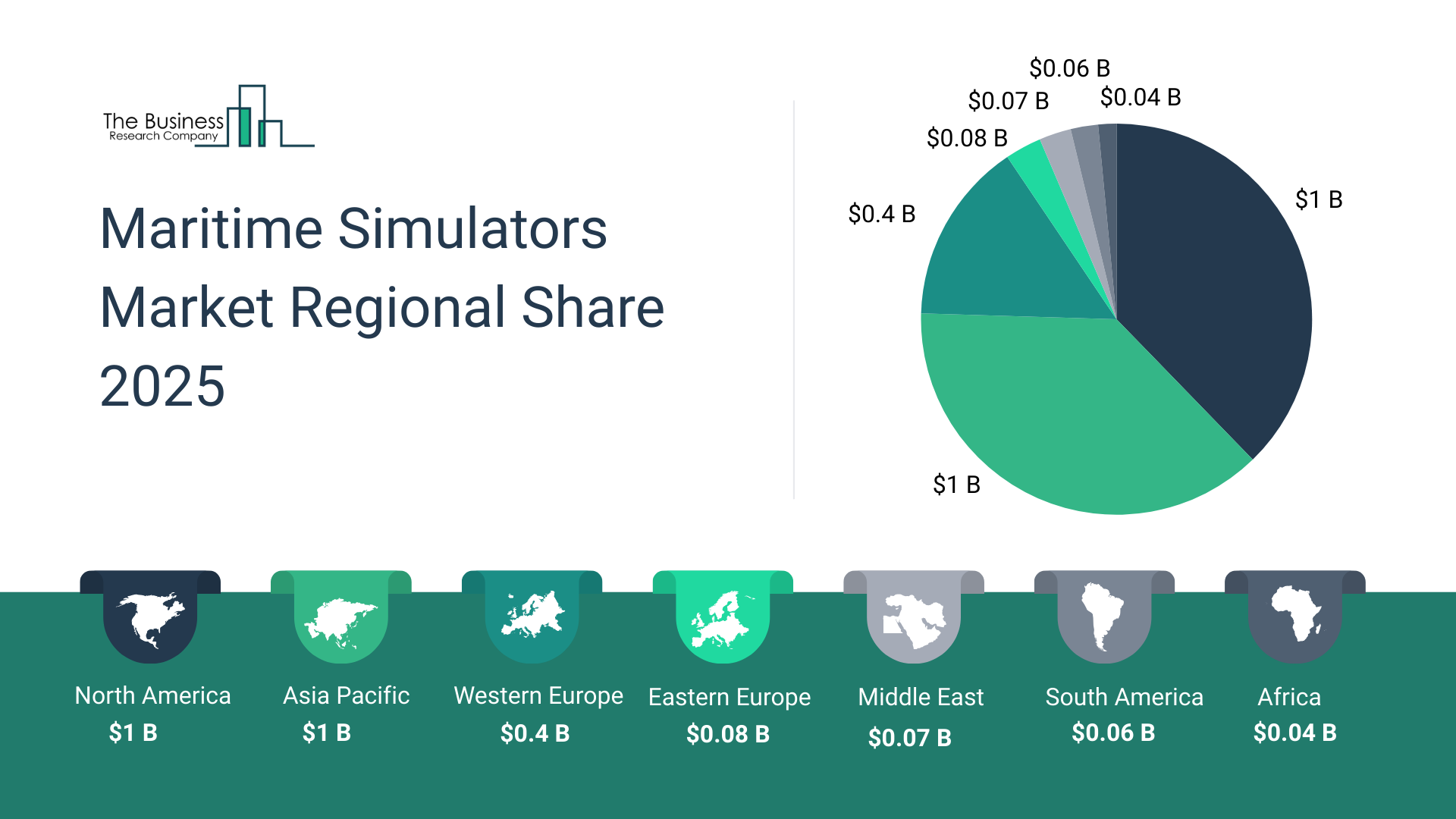
Asia Pacific will be the largest region in the maritime simulators market in 2029, valued at $716 million. The market is expected to grow from $475 million in 2024 at a compound annual growth rate (CAGR) of 9%. The strong growth is supported by the rise of port and offshore infrastructure projects and rising complexity of modern ships.
Which Will Be The Largest Country In The Global Maritime Simulators Market In 2029?
The USA will be the largest country in the maritime simulators market in 2029, valued at $590 million. The market is expected to grow from $468 million in 2024 at a compound annual growth rate (CAGR) of 5%. The strong growth can be attributed to the favorable government initiatives and growing demand for LNG.
Request a free sample of the Maritime Simulators Market report
https://www.thebusinessresearchcompany.com/sample_request?id=21511&type=smp
What will be Largest Segment in the Maritime Simulators Market in 2029?
The maritime simulators market is segmented by type into ship bridge simulators, engine room simulators, cargo handling simulators, communication or global maritime distress and safety system (GMDSS) simulators and other types. The ship bridge simulators market will be the largest segment of the maritime simulators market segmented by type, accounting for 46% or $915 million of the total in 2029. The ship bridge simulators market will be supported by the growing need for advanced navigational training, increased focus on reducing human error at sea, rising investments in maritime education infrastructure, stricter international regulations mandating simulator-based training, rapid digitalization of ship operations, increasing demand for competency assessments and integration of virtual reality to enhance user immersion.
The maritime simulators market is segmented by component into hardware, software and services. The hardware market will be the largest segment of the maritime simulators market segmented by component, accounting for 49% or $976 million of the total in 2029. The hardware market will be supported by demand for realistic simulation environments, advancements in sensor and motion platform technologies, increasing adoption of multi-screen and immersive hardware systems, requirement for modular and scalable simulator setups, rising investments in simulator infrastructure by maritime academies, growing use of haptic feedback systems and integration with physical ship controls for experiential learning.
The maritime simulators market is segmented by application into maritime schools, training centers, shipping companies, port authorities, oil and gas companies, government authorities, navies and coast guards and other applications. The maritime schools market will be the largest segment of the maritime simulators market segmented by application, accounting for 25% or $496 million of the total in 2029. The maritime schools market will be supported by growing student enrollment in marine careers, regulatory mandates for simulation-based training in curricula, government investments in maritime education, increasing partnerships with technology providers, demand for practical learning tools, the rising number of accredited training institutes and global efforts to meet STCW convention requirements.
The maritime simulators market is segmented by end user into in civilian and commercial and military and defense. The civilian and commercial market will be the largest segment of the maritime simulators market segmented by end user, accounting for 71% or $1,425 million of the total in 2029. The civilian and commercial market will be supported by growing global trade and merchant shipping activity, increasing demand for certified seafarers, rising investments in simulation-based training by shipping lines, shift toward decarbonization and alternative fuels requiring new training modules, focus on crew retention and skill enhancement, compliance with international standards such as STCW and proliferation of private maritime training institutes.
What is the expected CAGR for the Maritime Simulators Market leading up to 2029?
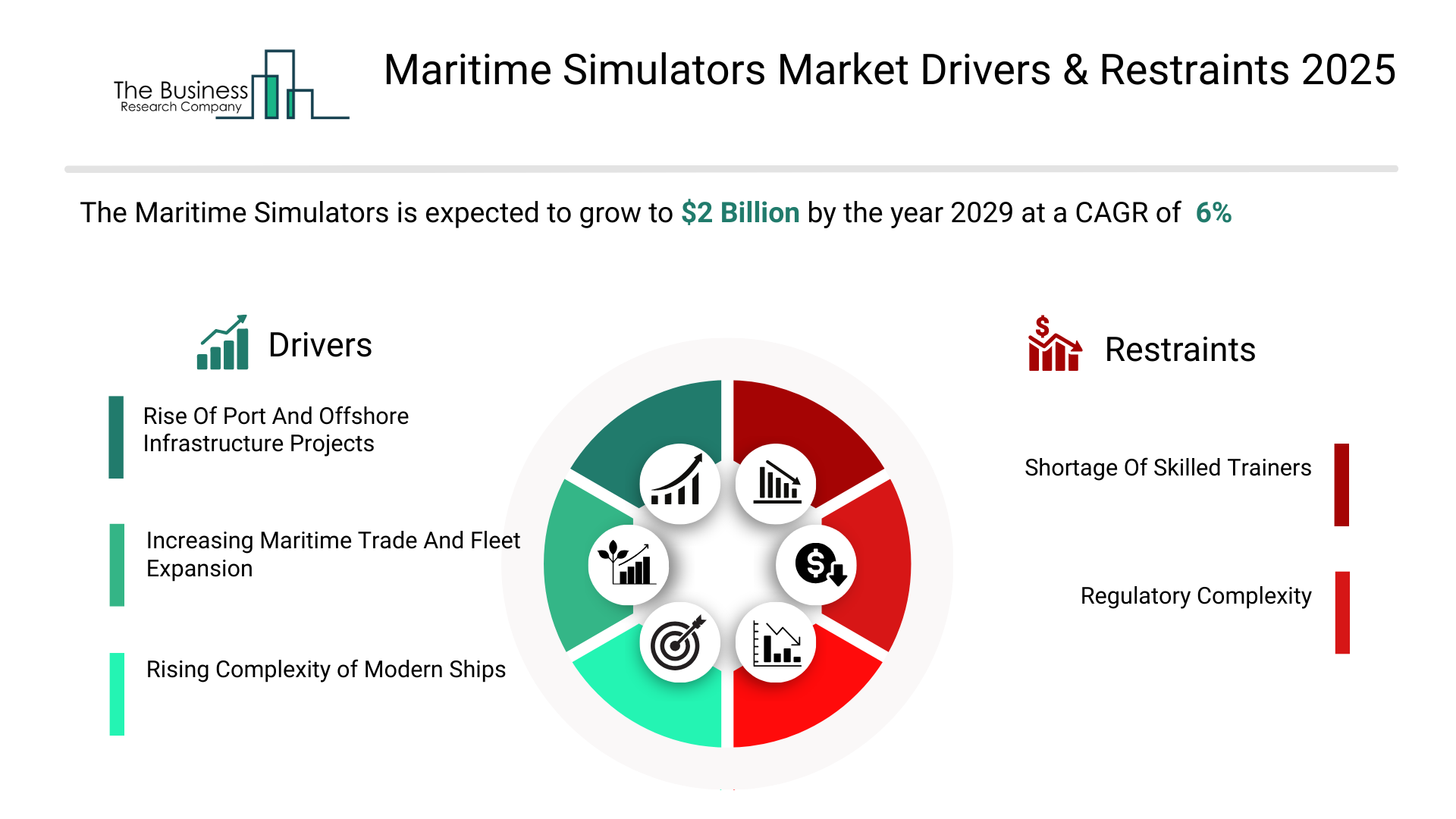
The expected CAGR for the maritime simulators market leading up to 2029 is 6%.
What Will Be The Growth Driving Factors In The Global Maritime Simulators Market In The Forecast Period?
The rapid growth of the global maritime simulators market leading up to 2029 will be driven by the following key factors that are expected to reshape maritime training, safety management, and operational efficiency worldwide.
Rise Of Port And Offshore Infrastructure Projects - The rise of port and offshore infrastructure projects will become a key driver of growth in the maritime simulators market by 2029. As investments increase in port expansions, new terminals, and offshore facilities like oil rigs, wind farms, and LNG terminals, the demand for highly skilled operators to manage these complex environments safely and efficiently rises accordingly. Specialized training is essential due to the operational challenges and risks associated with navigating congested waters, managing heavy cargo, and responding to emergencies in these settings. Maritime simulators offer a controlled, realistic platform for crews to develop these critical skills without risking vessels or infrastructure. As a result, the rise of port and offshore infrastructure projects is anticipated to contributing to a 1.8% annual growth in the market.
Increasing Maritime Trade And Fleet Expansion - The increasing maritime trade and fleet expansion will emerge as a major factor driving the expansion of the maritime simulators market by 2029. As international trade intensifies, the construction and deployment of new vessels accelerate to meet cargo transport needs worldwide. This fleet growth necessitates a larger pool of skilled seafarers capable of safely and efficiently managing complex operations. Simulator-based training offers a realistic, risk-free environment that enhances crew preparedness, safety, and operational performance. Additionally, stricter regulatory requirements make simulator training essential for certification and compliance. This combination of market expansion, safety priorities, and regulations is fueling strong growth in the maritime simulators market. Consequently, the increasing maritime trade and fleet expansion is projected to contributing to a 1.3% annual growth in the market.
Rising Complexity Of Modern Ships - The rising complexity of modern ships within digital manufacturing processes will serve as a key growth catalyst for the maritime simulators market by 2029. The increasing complexity of modern ships, featuring advanced systems like integrated bridges, automated propulsion, and digital navigation. Operating these complex systems requires specialized expertise, prompting maritime organizations to invest in high-fidelity simulators that provide safe, immersive environments for skill development. Maritime simulators provide a safe, efficient solution for developing these skills while minimizing operational risk. They enable scenario-based training for emergencies and reduce reliance on onboard instruction, lowering costs and downtime. With global operations and dispersed crews, cloud-based and (virtual reality) VR-enabled simulators offer flexible, standardized training across locations, driving their growing adoption in the maritime sector. Therefore, this rising complexity of modern ships is projected to supporting to a 1.1% annual growth in the market.
Growth In Naval Defense Budgets - The growth in naval defense budgets will become a significant driver contributing to the growth of the maritime simulators market by 2029. As nations boost their defense expenditure to modernize and expand naval capabilities, the demand for advanced training solutions to prepare personnel for complex maritime operations intensifies. Maritime simulators offer realistic, cost-effective environments to train crews in navigation, tactical maneuvers, and combat scenarios, eliminating the risks of live exercises. Modern naval vessels incorporate sophisticated technologies and weaponry that require highly skilled operators. Simulator-based training allows naval forces to practice handling these complex systems safely, enhancing operational readiness. Increased defense funding enables investment in state-of-the-art simulators that replicate real-world conditions, improving training effectiveness. Consequently, the growth in naval defense budgets is projected to contributing to a 0.8% annual growth in the market.
Access the detailed Maritime Simulators Market report here:
https://www.thebusinessresearchcompany.com/report/maritime-simulators-global-market-report
What Are The Key Growth Opportunities In The Maritime Simulators Market in 2029?
The most significant growth opportunities are anticipated in the civilian and commercial maritime simulators market, the ship bridge maritime simulators market, the maritime simulators hardware market, and the maritime simulators for schools market. Collectively, these segments are projected to contribute over $1 billion in market value by 2029, driven by increasing global emphasis on maritime safety, the rising demand for realistic and competency-based seafarer training, and the expansion of commercial and naval fleets worldwide. This surge is further supported by technological advancements in VR/AR-based simulation, improved hydrodynamic modeling, and integrated digital navigation systems that enhance training accuracy and operational preparedness. As ports, shipping companies, and maritime academies adopt advanced simulation platforms to meet stricter regulatory standards and optimize crew performance, these segments are positioned to fuel transformative growth within the broader maritime simulators industry.
The civilian and commercial maritime simulators market is projected to grow by $408 million, the ship bridge maritime simulators market by $259 million, the maritime simulators hardware market by $258 million, and the maritime simulators for schools market by $153 million over the next five years from 2024 to 2029.
The Business Research Company (www.thebusinessresearchcompany.com) is a leading market intelligence firm renowned for its expertise in company, market, and consumer research. We have published over 17,500 reports across 27 industries and 60+ geographies. Our research is powered by 1,500,000 datasets, extensive secondary research, and exclusive insights from interviews with industry leaders.
We provide continuous and custom research services, offering a range of specialized packages tailored to your needs, including Market Entry Research Package, Competitor Tracking Package, Supplier & Distributor Package and much more
Disclaimer: Please note that the findings, conclusions and recommendations that TBRC Business Research Pvt Ltd delivers are based on information gathered in good faith from both primary and secondary sources, whose accuracy we are not always in a position to guarantee. As such TBRC Business Research Pvt Ltd can accept no liability whatever for actions taken based on any information that may subsequently prove to be incorrect. Analysis and findings included in TBRC reports and presentations are our estimates, opinions and are not intended as statements of fact or investment guidance.
The Business Research Company
Americas +1 310-496-7795
Europe +44 7882 955267
Asia & Others +44 7882 955267 & +91 8897263534
Email: info@tbrc.info"
Oliver Guirdham
The Business Research Company
+44 7882 955267
info@tbrc.info
Visit us on social media:
LinkedIn
Facebook
X
Legal Disclaimer:
EIN Presswire provides this news content "as is" without warranty of any kind. We do not accept any responsibility or liability for the accuracy, content, images, videos, licenses, completeness, legality, or reliability of the information contained in this article. If you have any complaints or copyright issues related to this article, kindly contact the author above.
