

Smart Airport Market Growth Outlook 2035: US$ 18.37 Billion Valuation, 10% of CAGR, Powered by Smart Tech and Automation
Smart Airport Market
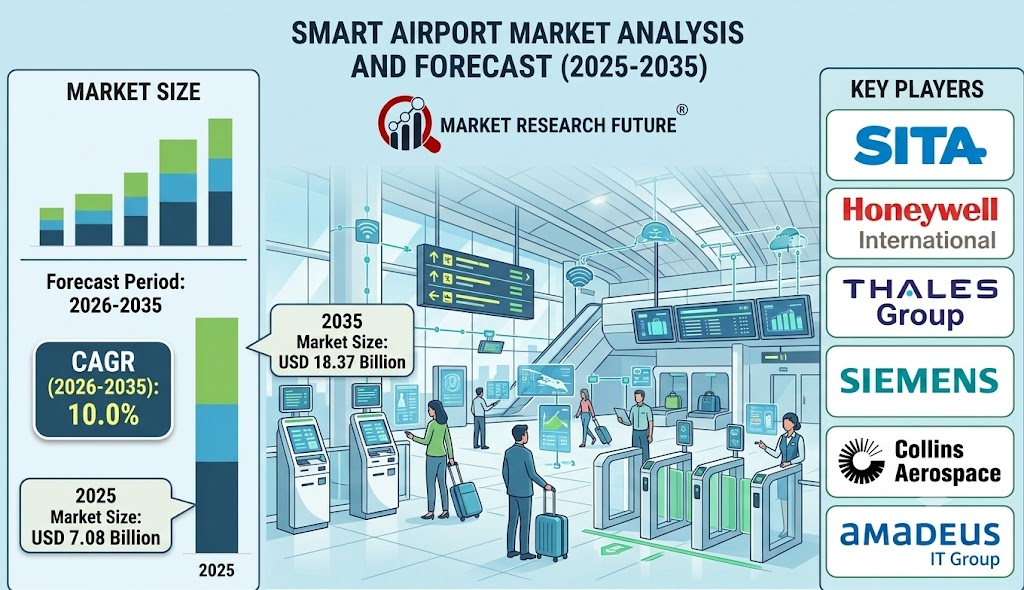
Smart airport market valued at USD 7.08 Billion in 2025, the market is projected to grow to USD 18.37 Billion by 2035, with a CAGR of 10.0% during 2026–2035.
NEW YORK, NY, UNITED STATES, July 21, 2026 /EINPresswire.com/ -- The Smart Airport Market is undergoing a significant transformation fueled by rapid digitalization, automation, and increasing passenger traffic worldwide. The study period from 2021 to 2035 reflects an accelerated shift toward integrated airport ecosystems where technology enhances operational efficiency, passenger experience, and security compliance.Smart airports leverage advanced technologies such as biometrics, artificial intelligence (AI), Internet of Things (IoT), and cloud-based platforms to streamline processes across terminal, landside, and airside operations. Increasing regulatory pressure, growing air passenger volumes, and the need for non-aeronautical revenue streams are pushing airports toward digital-first infrastructure.
Latest Market Trends:
The Smart Airport Market is shaped by evolving technological and operational trends that are redefining airport ecosystems globally.
1. Biometric-Driven Seamless Passenger Journeys
Airports are increasingly adopting biometric technologies such as facial recognition and digital identity platforms to enable frictionless passenger movement. From check-in to boarding, single-token travel systems reduce wait times and enhance security compliance. This trend is particularly strong in regions implementing strict identity verification regulations.
Request Sample of Report: https://www.marketresearchfuture.com/sample_request/5882
2. Integration of Digital Twin Technology
Digital twins are being deployed to create virtual replicas of airport operations. These systems allow real-time monitoring, predictive maintenance, and scenario planning. Airports can optimize energy consumption, reduce downtime, and improve asset utilization through simulation-based decision-making.
3. Adoption of 5G and IoT-Enabled Infrastructure
The deployment of 5G networks is enhancing connectivity across airport ecosystems. IoT devices enable real-time tracking of baggage, aircraft movement, and passenger flow. This interconnected environment improves operational visibility and responsiveness.
4. Rise of Autonomous Systems and Robotics
Airports are deploying autonomous vehicles for baggage handling, cleaning, and airside logistics. Robotics is also being used for customer service, reducing human intervention while improving efficiency and scalability.
5. Cloud-Based Airport Platforms
Migration toward cloud infrastructure is enabling scalable and flexible airport management systems. Software-as-a-Service (SaaS) models are replacing legacy systems, allowing airports to reduce costs and improve system interoperability.
Key Market Drivers:
1. Regulatory Biometric Mandates (~18–22% Impact on CAGR)
Governments and aviation authorities are mandating biometric identity verification systems to enhance security. Initiatives such as EU Entry/Exit System (EES) and TSA Credential Authentication Technology (CAT) are accelerating adoption in Europe and North America. These regulations are driving immediate investments in biometric infrastructure.
2. 5G and IoT Infrastructure Development (~15–18%)
The expansion of high-speed connectivity networks is enabling real-time data exchange across airport systems. This driver is particularly impactful in Asia-Pacific and the Middle East, where new airport projects are integrating digital infrastructure from inception.
3. Passenger Experience and Revenue Optimization (~12–15%)
Airports are under pressure to enhance passenger satisfaction while increasing non-aeronautical revenue streams. Smart technologies such as personalized retail offers, digital wayfinding, and automated services are improving customer engagement and spending.
4. Digital Twin and Predictive Maintenance (~10–13%)
Airports are investing in predictive analytics to reduce operational disruptions. Digital twins help forecast maintenance needs, optimize asset usage, and minimize downtime, improving overall efficiency.
5. Greenfield Mega-Hub Development (~10–12%)
Emerging economies are investing in large-scale airport infrastructure projects. These greenfield developments are integrating smart technologies from the design phase, driving long-term market growth.
6. Shift to Managed Services and SaaS Models (~8–10%)
Airports are transitioning from capital-intensive IT systems to subscription-based services. Managed service providers offer scalable solutions, reducing operational complexity and upfront costs.
7. Sustainability and ESG Compliance (~5–8%)
Environmental regulations are pushing airports to adopt energy-efficient systems and reduce carbon footprints. Smart energy management and reporting tools are becoming essential components of airport operations.
Key Opportunities:
Airport-as-a-Platform Revenue Models - Airports are evolving into digital platforms that integrate retail, mobility, and logistics services. Data-driven ecosystems enable monetization through partnerships, advertising, and personalized services.
Emerging Market Greenfield Mega-Hubs - Rapid urbanization in Asia-Pacific, Middle East, and Africa is driving the development of new airports. These projects offer opportunities for end-to-end smart infrastructure deployment.
Autonomous Airside and Landside Logistics - Automation in baggage handling, cargo movement, and passenger transport is creating new efficiencies. Autonomous systems reduce operational costs and improve safety.
Recent Developments:
March 2025 – SITA
Introduced the Smart Path TS6 biometric platform, enabling a single-token travel experience across multiple touchpoints including check-in, lounge access, and boarding. This innovation enhances passenger convenience and reduces processing time across airports globally.
November 2024 – Honeywell International
Launched an integrated Airport Operations Management Suite combining digital twin technology, energy optimization, and predictive maintenance. This unified platform allows airport operators to manage operations through a centralized dashboard.
September 2024 – NEC Corporation
Expanded the DigiYatra biometric e-gate deployment across 25 airports in India. This initiative improves passenger throughput and supports the government’s vision of a seamless travel experience.
March 2024 – Amadeus IT Group
Partnered with Dubai Airports to implement an AI-powered passenger flow prediction system at Terminal 3. The solution enhances crowd management and operational efficiency through real-time analytics.
Profiles of Top Companies:
The Smart Airport Market is moderately consolidated, with leading players offering integrated solutions across hardware, software, and services.
SITA (~7–10%) - A specialized aviation IT provider offering passenger processing systems, baggage tracking solutions, and airport operations platforms. Its strong global presence across 400+ airports positions it as a key innovator in smart airport ecosystems.
Honeywell International (~5–8%) - Provides building automation, security systems, and IoT-enabled platforms. Its expertise in industrial automation enables comprehensive airport infrastructure solutions.
Thales Group (~5–7%) - Focuses on biometric identity solutions, cybersecurity, and air traffic management systems. Its dual presence in defense and civil aviation strengthens its technological capabilities.
Siemens AG (~4–7%) - Offers smart building technologies, energy management systems, and fire safety solutions. Its integrated portfolio supports sustainable airport development.
Collins Aerospace (RTX) (~4–6%) - Provides self-service kiosks, biometric boarding systems, and ARINC operational platforms. It plays a critical role in airline-airport integration.
Amadeus IT Group (~3–6%) - Specializes in passenger flow management, cloud-based platforms, and common-use systems. Its deep integration with airline systems enhances operational efficiency.
IBM Corporation (~3–5%) - Delivers AI-driven analytics, hybrid cloud solutions, and asset management systems. Its consulting expertise supports large-scale digital transformation projects.
Cisco Systems (~2–4%) - Supplies network infrastructure, cybersecurity solutions, and 5G connectivity platforms, forming the backbone of smart airport communication systems.
NEC Corporation (~2–4%) - A leader in biometric technologies, offering facial recognition systems and digital identity solutions widely adopted in Asia-Pacific.
Leidos Holdings (~2–3%) - Focuses on security screening technologies, including CT scanners and automated tray return systems, particularly in collaboration with regulatory authorities.
Regional Analysis:
The Smart Airport Market demonstrates varied growth patterns across regions based on infrastructure maturity and investment priorities.
North America (36.0% Market Share in 2025) - The region leads due to advanced infrastructure and strong regulatory frameworks. Investments in TSA modernization and airline partnerships are driving technology adoption.
Europe (26.0% Market Share) - Growth is driven by compliance with EU Entry/Exit System (EES) and initiatives like the Single European Sky program. Airports are focusing on biometric integration and sustainability.
Asia-Pacific (Fastest Growth – 12.0% CAGR) - Rapid urbanization and increasing passenger traffic are driving demand for new airports. Investments in 5G infrastructure and large-scale airport projects are key growth factors.
South America (USD 0.50 Billion Market Size) - The region is witnessing growth through public-private partnerships (PPP) aimed at upgrading airport terminals and improving operational efficiency.
Middle East & Africa (USD 0.57 Billion Market Size) - Government initiatives such as Vision 2030 are driving airport expansion projects. The region is investing heavily in smart technologies to enhance global connectivity.
Segment Analysis:
The Smart Airport Market is comprehensively segmented based on technology, solution, application, airport size, and airport technology level. Each segment plays a critical role in shaping the operational efficiency, passenger experience, and digital transformation journey of modern airports.
1. By Technology
Security Systems - This segment forms the backbone of smart airport infrastructure, focusing on advanced screening, surveillance, and biometric identification systems. Technologies such as facial recognition, automated border control gates, and AI-powered threat detection are widely deployed to meet stringent regulatory requirements. The increasing adoption of biometric mandates across regions is significantly strengthening this segment, ensuring faster passenger processing while maintaining high security standards.
Communication Systems - Communication systems enable seamless data exchange between various airport stakeholders, including airlines, ground staff, and control authorities. This segment includes network infrastructure, wireless communication technologies, and real-time data platforms. The integration of 5G and IoT is transforming communication capabilities, allowing airports to operate with enhanced coordination, reduced delays, and improved situational awareness.
Air & Ground Traffic Control - This segment focuses on technologies that manage aircraft movement both in the air and on the ground. Advanced air traffic management systems, ground radar, and automated guidance systems are used to ensure safe and efficient aircraft operations. With increasing air traffic volumes, airports are investing in intelligent control systems that reduce congestion, optimize runway usage, and enhance overall operational safety.
Other Technologies
This category includes emerging technologies such as artificial intelligence, machine learning, cloud computing, and digital twin platforms. These technologies support predictive analytics, real-time decision-making, and system integration across airport operations. Their role is expanding rapidly as airports transition toward fully digital and autonomous ecosystems.
2. By Solution
Hardware - The hardware segment includes physical infrastructure such as self-service kiosks, biometric scanners, surveillance cameras, sensors, and automated baggage handling systems. These components are essential for implementing smart airport functionalities and serve as the interface between passengers and digital systems. Continuous advancements in hardware design are improving durability, efficiency, and user experience.
Software - Software solutions act as the intelligence layer of smart airports, enabling data processing, analytics, and system integration. This includes airport management systems, passenger flow analytics platforms, and cloud-based operational tools. The shift toward Software-as-a-Service (SaaS) models is allowing airports to scale operations efficiently while reducing IT maintenance costs.
Services - The services segment includes consulting, system integration, maintenance, and managed services. As airport systems become more complex, the demand for specialized service providers is increasing. Managed services, in particular, are gaining traction as airports seek to outsource operations and focus on core competencies while ensuring continuous system performance.
3. By Application
Terminal Side - Terminal-side applications focus on enhancing passenger experience and operational efficiency within airport terminals. This includes check-in automation, biometric boarding, security screening, and retail management systems. Smart technologies in this segment are designed to reduce wait times, improve passenger flow, and increase non-aeronautical revenue through personalized services.
Airside - Airside applications involve aircraft operations, including ground handling, fueling, maintenance, and runway management. Technologies such as automated ground vehicles, real-time monitoring systems, and predictive maintenance tools are improving efficiency and safety in this segment. The adoption of autonomous solutions is further transforming airside operations.
Landside - Landside applications cover areas outside the terminal, including parking management, public transportation integration, and access control systems. Smart parking solutions, digital wayfinding, and mobility integration platforms are enhancing passenger convenience and optimizing traffic flow around airports.
4. By Airport Size
Large Airports - Large international airports handle high passenger volumes and require advanced, fully integrated smart solutions. These airports are early adopters of cutting-edge technologies such as AI-driven analytics, biometric systems, and digital twins. Their significant investment capacity allows for comprehensive digital transformation initiatives.
Medium Airports - Medium-sized airports are adopting smart technologies selectively to improve efficiency and passenger experience. While they may not implement full-scale smart ecosystems, they focus on high-impact areas such as security systems and passenger processing solutions.
Small Airports - Small airports are gradually adopting cost-effective smart solutions to enhance operations. Their focus is on scalable and modular technologies that can be implemented with limited budgets while still delivering efficiency improvements.
5. By Airport Technology
Airport 2.0 - Represents the initial phase of digital adoption, where airports implement basic IT systems and partial automation. These airports rely on traditional processes with limited integration between systems.
Airport 3.0 - In this stage, airports adopt advanced automation and begin integrating multiple systems. Technologies such as IoT, data analytics, and partial cloud adoption enable improved coordination and operational visibility.
Airport 4.0 - Airport 4.0 represents the most advanced stage, characterized by fully integrated digital ecosystems. These airports leverage AI, real-time analytics, and autonomous systems to create seamless, data-driven operations. The focus is on predictive decision-making, enhanced passenger experience, and sustainable operations.
Conclusion:
The Smart Airport Market is poised for substantial growth, driven by technological innovation, regulatory mandates, and increasing demand for efficient airport operations. With a projected value of USD 18.37 Billion by 2035, the market presents significant opportunities for stakeholders across technology providers, airport operators, and investors. As airports transition toward fully integrated digital ecosystems, the focus will remain on enhancing passenger experience, optimizing operations, and achieving sustainability goals.
Browse More Reports::
Airport IOT Market
https://www.marketresearchfuture.com/reports/airport-iot-market-6722
Future of Airport Market
https://www.marketresearchfuture.com/reports/future-of-airport-market-24159
Airport 4.0 Market
https://www.marketresearchfuture.com/reports/airport-4-0-market-31574
Sagar Kadam
Market Research Future
+1 628-258-0071
sales@marketresearchfuture.com
Legal Disclaimer:
EIN Presswire provides this news content "as is" without warranty of any kind. We do not accept any responsibility or liability for the accuracy, content, images, videos, licenses, completeness, legality, or reliability of the information contained in this article. If you have any complaints or copyright issues related to this article, kindly contact the author above.
